


Agentic AI
The Executive Guide to Scaling SaaS Teams With Agentic AI Co-Workers
SaaS companies in 2026 face a simple truth that human teams alone can't keep up with explosive growth. Development takes too long, support tickets pile up, and compliance checks eat up weeks. Agentic AI Co-Workers fix this by acting like tireless team members who handle routine work, think through problems, and only ask humans for help on tough calls.
What Exactly Is an Agentic AI Co-Worker?
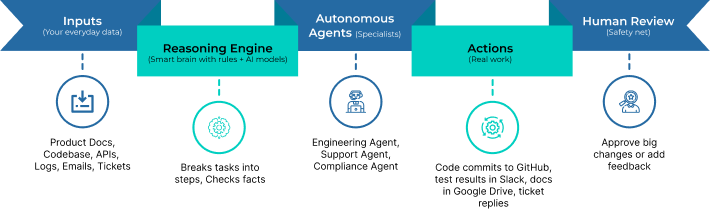
What if you hired a coworker who never sleeps, remembers every detail from past projects, and jumps into any task without training. That's an Agentic AI Co-Worker. These smart systems break down complex jobs into steps, use your company's docs and tools to get work done, and team up with your staff seamlessly.
They shine across departments. An Engineering Co-Worker drafts product specs, writes basic tests, or fixes small bugs. A Product Co-Worker sums up customer feedback or drafts release notes. Compliance Co-Workers pull together SOC 2 reports automatically. Support Co-Workers answer simple tickets on their own, freeing humans for tricky ones.
Unlike basic chatbots that give one-off answers, these co-workers remember context like a conversation from the past and take real actions, such as updating a database or sending an email.

The 4 SaaS Teams That Benefit Most From AI Co-Workers

Engineering Team
Engineers spend hours on repetitive chores that slow down real innovation. AI Co-Workers change that by auto-generating starter code for new features, writing unit tests to check if code works, spotting performance issues in apps, sketching simple diagrams, and even creating scripts to move data during upgrades.
Sprints that used to take two weeks now wrap up in days. Developers focus on creative problem-solving instead of boilerplate, cutting team costs without losing quality.

Product Management Team
Product managers drown in admin work, reading feedback, chasing market trends, and writing docs. AI Co-Workers handle user research summaries from surveys and reviews, gather intel on competitors' features, draft release notes for launches, create first versions of product requirement documents (PRDs), and compare rival products side-by-side.
Now PMs act like strategists: prioritizing features that win customers instead of typing reports. They ship better products faster, staying ahead in crowded markets.

Customer Support Team
Support queues grow as customers do, but you can't hire fast enough. Support AI Co-Workers resolve Level 1 and 2 tickets like password resets or basic setup without human help. They update your knowledge base with fresh answers from real chats and pass complex issues to staff with full context, like chat history and steps tried.
Results show up quickly, such as, ticket costs drop per resolution, customer satisfaction scores climb because waits shrink, and agents handle peaks like Black Friday without burnout.

DevSecOps Team
Security and ops teams juggle endless checks that halt deployments. DevSecOps AI Co-Workers run CI/CD pipeline tests automatically, scan code for vulnerabilities, validate compliance rules like SOC 2, and dig through logs to find issues before they blow up.
This means round-the-clock monitoring with zero missed alerts. Teams catch problems early, deploy safely, and avoid fines from compliance slips.
Architecture View: How AI Co-Workers Integrate Into SaaS Teams
Build vs. Buy: SaaS Executive Decision Guide
| Scenario | Build Custom | Buy Ready-Made |
|---|---|---|
| Unique workflows (e.g., custom billing logic) |

|
- |
| Complex engineering tasks (e.g., architecture design) |
|
- |
| Simple repetitive tasks (e.g., ticket routing) |
|
|
| High compliance load (e.g., SOC 2 custom rules) | - |
(with tweaks)
|
| Customer support (L1 tickets) | - |
|
Invimatic supports your agentic AI strategy at every step.
Build or Buy
90-Day Roadmap for Deploying AI Co-Workers in SaaS Teams
Phase 1 – Assessment (Weeks 1–3): Pinpoint pain points through quick audits. Map key workflows like ticket handling or code reviews. Pick 3–5 high-impact use cases, like auto-tests or feedback summaries.
Phase 2 – Build & Integrate (Weeks 4–8): Sketch multi-agent setups where specialists hand off tasks. Hook into your APIs, databases, and tools like GitHub or Zendesk. Test small to iron out kinks.
Phase 3 – Scale (Weeks 9–12): Roll out cross-team agents, like one linking product and engineering. Build feedback loops so agents learn from human tweaks. Track KPIs and expand to more teams.
Risks & How To Mitigate Them
Over-automation feels scary, but add "human-in-the-loop" for big decisions, agents suggest, you approve. Security worries? Use role-based access like your current logins, plus full audit logs of every move.
AI "hallucinations" (making up facts) vanish with grounding techniques: real docs via RAG, strict rules, and double-check layers. Team pushback? Short training shows how agents save time, turning skeptics into fans.
Why Invimatic Is the Ideal Partner for AI Co-Workers
Invimatic helps SaaS companies deploy production-grade Agentic AI Co-Workers that speed up development, slash operational costs, and back teams 24/7. Our AI architects craft engineering agents, support agents, compliance agents, and multi-agent systems fitted to your exact workflows, delivered via our proven 90-day framework.
Ready to scale smarter with AI? Talk to an AI Architect today!
Scale Smarter Today



Your email address will not be published. Required fields are marked *