



Agentic AI
Is AI Agent Development Worth It for Mid-Market Saas?
The Short Answer: For mid-market SaaS companies ($5M–$100M ARR), AI agent development is worth the investment when three conditions are met: your data is structured, the workflow is repeatable, and you have internal ownership of the outcome.
Companies that scope narrowly on their first deployment report 3x higher ROI in year one than those who attempt platform-wide automation. Those that overbuild rarely recover the investment within 24 months.
Defining the Key Concepts
Before we dive into the economics, we must align on the terminology. The market is currently flooded with AI-powered marketing speak; here is the technical reality for the mid-market.
- AI Agent: An autonomous software system that perceives inputs, reasons across them, and executes multi-step actions across tools and systems without continuous human direction. Unlike a chatbot, it doesn’t wait to be asked, it acts.
- AI Agent ROI: The measurable return on agent deployment, calculated against baseline metrics like hours saved, ticket deflection rate, churn reduction, or revenue influenced, tracked within a 60–180 day window.
Your Competitors Are Already Running AI Agents
- In the last 12 months, the conversation in SaaS boardrooms has shifted. It is no longer about AI doing basic tasks such as generating texts, but about automated workflows. How an autonomous agent can handle the $200k-a-year churn problem or the bottleneck in customer onboarding.
- And, the stakes are immediate, because this is no longer a future trend, but a very important present decision that can decide the future of the company.
- If your competitor automates 60% of their Tier-1 support while maintaining a higher CSAT, they are not just saving money, but also reallocating that capital to out-spend you on R&D and customer acquisition.
- And, all this sounds good,but when you begin to actually get things done, it can be quite challenging. So, before you greenlight a $150K build, let’s talk about what’s actually working, and what’s quietly failing in deploying AI gents for mid-sized SaaS companies.
Why Deploying AI Agents is a Harder Decision for Mid-Sized Companies?
Enterprise companies have infinite budgets to fail fast. Early-stage startups can pivot their entire product on a whim. Mid-market SaaS is caught in an uncomfortable position: too large to ignore AI, but too lean to experiment recklessly.
You are likely facing:
- AI-Native Competition: New entrants building agent-first workflows that bypass the UI-heavy friction of legacy SaaS.
- The "Off-the-Shelf" Ceiling: Basic ChatGPT wrappers hit a ceiling once your operational complexity passes $10M ARR.
- The Build vs. Buy Paralysis: Do you wait for a platform giant to release a native agent, or build a custom solution to protect your moat?
Agentic AI for Enterprise SaaS: When to Build vs Buy AI Agents
Explore More
The primary failure mode in mid-market AI agent deployment isn't technical, but organizational. Most teams underestimate change management costs by 40–60%, which erodes ROI before the agent ever goes live.
Why do companies really need AI Agents?
An AI agent is like a junior operator who never sleeps, never misses a trigger, and never needs a status update meeting. They are autonomous extensions of your team that move the needle on your most critical KPIs.
High-Impact Agent Use Cases
| Agent Type | SaaS Function | Targeted Outcome |
|---|---|---|
| Onboarding Agent | Customer Success | Drastically reduces time-to-value by guiding users through complex setups in real-time. |
| Churn Intervention Agent | Retention | Identifies subtle behavioral shifts to flag at-risk accounts weeks before a renewal date. |
| Support Triage Agent | Operations | Autonomously resolves Tier-1 tickets, allowing your team to focus on high-touch technical escalations. |
| Revenue Signal Agent | Sales / PLG | Monitors product usage data to surface expansion and upsell opportunities. |
| Internal Ops Agent | RevOps / Finance | Eradicates manual data entry by auto-syncing CRM records and auditing anomalies. |
Move beyond the basics and make your tech stack work for you without adding overhead. Contact Invimatic today.
The Real Investment Beyond the Initial Build
At Invimatic, we focus on Total Cost of Ownership (TCO) to ensure your agents remain assets, not technical debt. Leadership must look past the sticker price and evaluate four structural layers:
- Engineering & Architecture: Whether using frameworks like LangChain and CrewAI or specialized low-code platforms, the value lies in the architecture: robust prompt engineering, secure API integration, and data permissioning.
- Infrastructure & Compute: Infrastructure costs (using models like GPT-4o or Claude 3.5 Sonnet) will scale alongside your user activity and agent autonomy.
- Performance Integrity & Maintenance: The AI landscape is fluid. We bake maintenance into our roadmap to ensure agents don’t break as models drift or your product UI evolves.
- Change Management: This is the ROI maker. Success is realized only when your team’s workflows are redesigned to complement the AI, ensuring a seamless human-in-the-loop transition.
Investment Summary
| Investment Layer | Focus Area | Criticality |
|---|---|---|
| Development | Custom logic and secure integration | High |
| Infrastructure | Model tokens and compute scaling | Scalable |
| Maintenance | Drift monitoring and workflow updates | Essential |
| Change Management | Team adoption and process redesign | Non-negotiable |
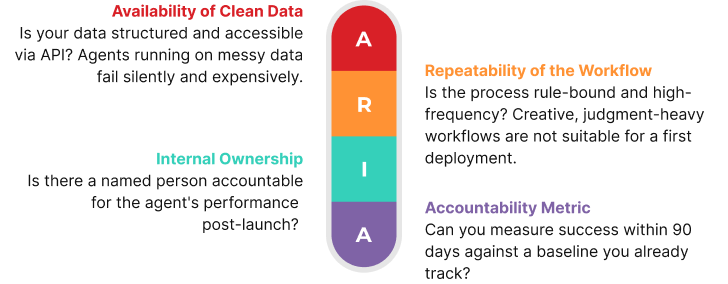
The ARIA Framework
How do you know if you're ready? Use the ARIA Framework, which is an Automation Readiness Index for AI Agents, to evaluate your project:
Conclusion
The companies that struggle in three years won't be the ones that moved too fast. They’ll be the ones that waited for a certainty that never came or built too big before they’d earned the right to scale.
Get in touch to discuss AI agent development for SaaS, built for scale, security, and real-world workflows.




FAQs
What's the difference between an AI agent and a chatbot?
How long does AI agent development take?
Should mid-market SaaS companies build or buy AI agents?
How do you measure the ROI of an AI agent?